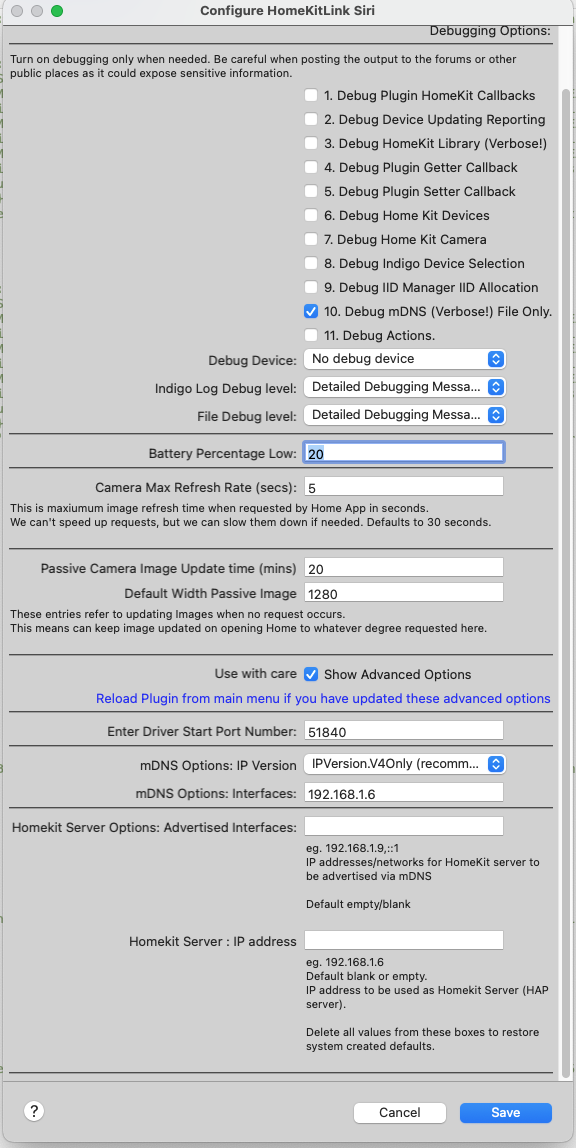
So the first test you had me do:
Code: Select all
unifi:~ jaymoo$ route -n get 224.0.0.251
   route to: 224.0.0.251
destination: 224.0.0.251
  interface: en0
      flags: <UP,HOST,DONE,LLINFO,WASCLONED,MULTICAST,IFSCOPE>
 recvpipe  sendpipe  ssthresh  rtt,msec    rttvar  hopcount      mtu     expire
       0         0         0         0         0         0      1500         0
Code: Select all
unifi:~ jaymoo$ python3 -c "
> import socket
> s = socket.socket(socket.AF_INET, socket.SOCK_DGRAM)
> s.setsockopt(socket.IPPROTO_IP, socket.IP_MULTICAST_IF, socket.inet_aton('192.168.1.3'))
> s.sendto(b'test', ('224.0.0.251', 5353))
> print('OK')
> "
Traceback (most recent call last):
  File "<string>", line 5, in <module>
    s.sendto(b'test', ('224.0.0.251', 5353))
    ~~~~~~~~^^^^^^^^^^^^^^^^^^^^^^^^^^^^^^^^
OSError: [Errno 65] No route to host
 -- not only was this error thrown (like the error we both pointed out in the logs) BUT -- TERMINAL popped up a message saying "Do you wish to allow Terminal to discover devices on the network?"
When I clicked on "Yes", a SUBSEQUENT run showed this:
Code: Select all
unifi:~ jaymoo$ python3 -c "
> import socket
> s = socket.socket(socket.AF_INET, socket.SOCK_DGRAM)
> s.setsockopt(socket.IPPROTO_IP, socket.IP_MULTICAST_IF, socket.inet_aton('192.168.1.3'))
> s.sendto(b'test', ('224.0.0.251', 5353))
> print('OK')
> "
OK
unifi:~ jaymoo$
I'm wondering if there is a bash/CLI way to issue that permission so that it is no longer denied access?